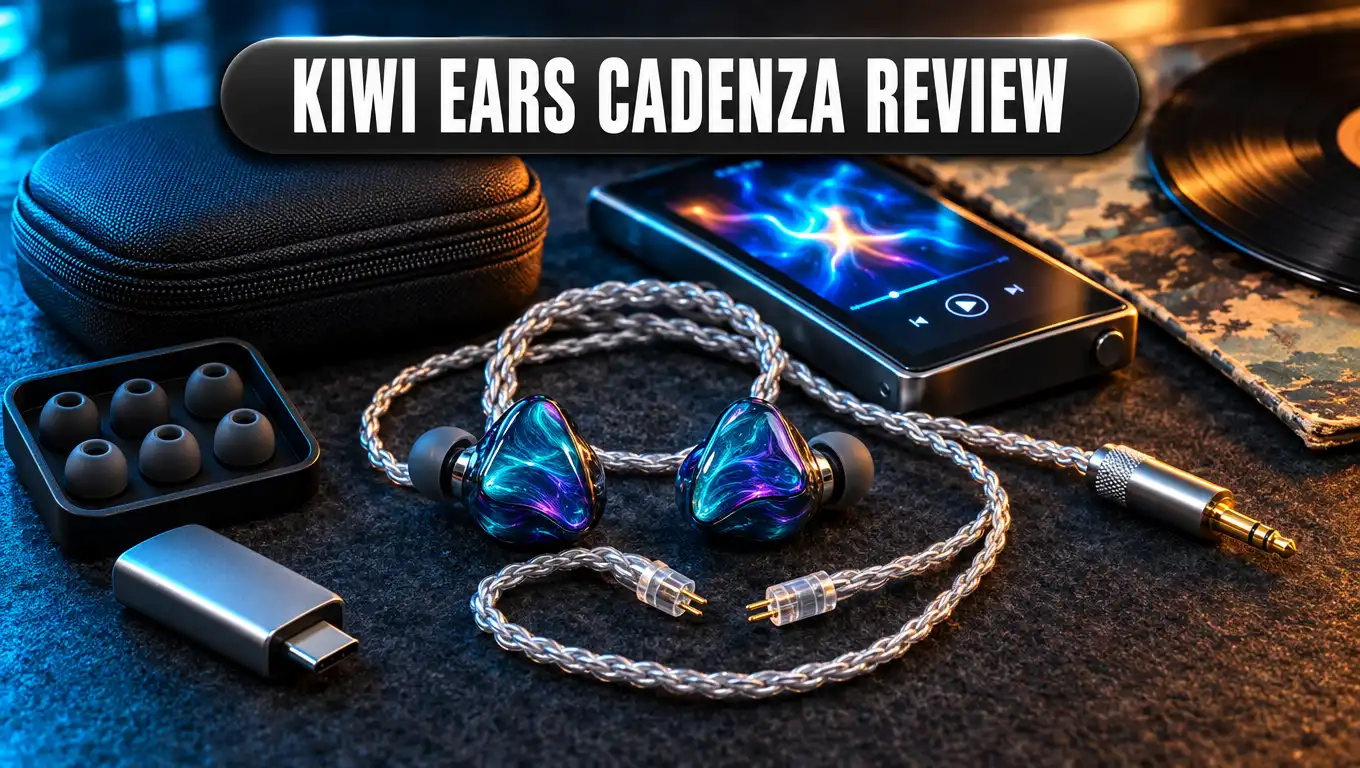
Kiwi Ears Cadenza Review: Budget IEM With a Beryllium Driver?
Do you want great sound without spending a lot? Many cheap earphones promise big things and then let you down. The Kiwi Ears Cadenza is different.
This small IEM costs about $35. It uses a 10mm beryllium dynamic driver, which is a premium material you usually find in costly gear. Listeners love its clean treble and balanced tone.
In this review, we test the build, comfort, bass, mids, treble, and soundstage. We also compare it with the newer Cadenza II and three solid rivals. By the end, you will know if the Cadenza belongs in your ears.
In a Nutshell
- Great value for the price: The Kiwi Ears Cadenza sells for around $35. It delivers sound quality that competes with IEMs up to about $80. For beginners, this makes it one of the smartest first purchases in the budget IEM market.
- Premium driver material: It uses a single 10mm dynamic driver with a beryllium diaphragm. Beryllium is light and stiff. This helps the driver respond fast and keeps distortion low, so the sound feels clean and quick.
- Balanced and natural tuning: Kiwi Ears tuned the Cadenza close to its own take on the Harman target. The bass is tight and controlled. The mids are open. The treble is crisp but never harsh, so you can listen for hours without fatigue.
- Light and pretty shell: The shell uses 3D printed medical grade resin. It comes in swirly colors like red, purple, green, and blue. It feels solid and weighs very little, though the small shell may not fit every ear.
- Some weak spots: The stock ear tips feel cheap and are hard to mount. The 3.5mm plug is wide, so it may not fit through some phone cases. Bass lovers may also want more punch and rumble.
- Easy to drive, but likes a dongle: With 32 ohms impedance and 110 dB sensitivity, a phone can drive it. Still, a small USB DAC dongle helps it sound fuller, punchier, and more detailed.
Kiwi Ears Cadenza

- ...
- 𝐇𝐢𝐠𝐡𝐞𝐫 𝐀𝐮𝐝𝐢𝐨 𝐑𝐞𝐬𝐨𝐥𝐮𝐭𝐢𝐨𝐧: The diaphragms of...
Last update on 2026-11-27 / Affiliate links / Images from Amazon Product Advertising API
The Kiwi Ears Cadenza is a single dynamic driver IEM that came out in 2022. Kiwi Ears is a young Chinese brand owned by Linsoul Audio. The Cadenza is the entry model in the brand’s lineup.
Above it sit the Quartet, the Quintet, the Orchestra Lite, and the Orchestra. Those cost much more. The Cadenza gives you a taste of the brand’s tuning at a very friendly price.
The star of the show is the driver. It is a 10mm dynamic driver with a beryllium diaphragm. High end headphones like the Focal Utopia use beryllium too. The metal is very light and very stiff, and that combo helps produce accurate sound.
A stiff, light diaphragm moves quickly with the music. It stops quickly too. This gives you tight bass, clean mids, and clear treble with less smearing.
Kiwi Ears tuned the Cadenza for a natural sound. The tuning comes from the driver design and the shape of the acoustic chamber inside the shell. The goal is simple: make music sound real and pleasant.
Many budget IEMs push heavy bass or sharp treble to grab attention. The Cadenza does not do that. It aims for balance over hype, and most listeners say it hits that goal.
Who is this IEM for? It suits beginners who want their first good pair. It also suits seasoned listeners who want a cheap, reliable daily driver. If you enjoy vocals, acoustic music, jazz, and classical, you will feel right at home.
In short, the Cadenza packs premium ideas into a budget body. Let us look closer at what you get.
Specifications and What Comes in the Box
Specs help you understand how an IEM will behave with your devices. The Cadenza has simple, friendly numbers. Here is a quick look at the key details.
The driver is a 10mm beryllium dynamic driver. The impedance is 32 ohms. The sensitivity is 110 dB SPL/mW. The frequency range covers 20 Hz to 20 kHz, which matches the full range of human hearing.
The shell material is medical grade resin. The cable uses a 0.78mm 2 pin connector on the earphone side. On the other end, you get a standard 3.5mm angled plug.
What do these numbers mean for you? The 32 ohm impedance and 110 dB sensitivity mean a phone or laptop can drive it. You do not need a big amp. Still, extra clean power helps it shine.
The 2 pin connector is a big plus. You can swap the cable if it breaks or if you want a balanced cable. This makes the Cadenza last longer than earphones with fixed wires.
Inside the box, you get a modest kit. It includes the two earpieces, one cable, and three sets of silicone ear tips. Each set comes in small, medium, and large sizes.
The three sets of tips look different in color. They seem to share the same silicone build. Sadly, you get no carrying case or pouch.
At this price, the slim bundle makes sense. Kiwi Ears spent the money on the driver and the shell. That is a smart trade for most buyers.
Our tip: set aside a few dollars for better third party ear tips and a cheap pouch. These small extras will improve both sound and storage. You will still spend less than many rival IEMs cost.
Build Quality and Design
The Cadenza looks far more costly than it is. The shell uses 3D printed medical grade resin. It feels smooth and solid in the hand. It is also very light.
The faceplates have a swirly, painted look. They come in colors like red, purple, green, and blue. Each shell looks a bit like a small gem. Many owners say the design was one reason they bought it.
The shells are small. This helps people with small ears. It also helps the Cadenza sit flush and stay low profile. However, a few users with larger ears find the fit a little loose.
The nozzle is fairly wide, while the stem is short. This shape can make tips tough to mount. Some reviewers had to use different tip sizes in each ear to get a good seal.
The cable is light and comfy. It has preformed ear hooks near the earpieces. These hooks keep the cable around your ears and stop it from slipping. The cable also has a bit of grip, so it tangles less.
There is one known flaw with the cable. The 3.5mm plug is wide and flat. It lacks the slim neck that helps a plug fit through tight phone case holes. Some users must remove their case to plug in.
The ear tips are the weakest part. They feel cheaper than the shells and cable. They fit very tightly on the nozzle and are hard to put on. Some reviewers also felt the sizes were not consistent.
Still, these flaws are easy to fix. A new tip set or a cable swap costs little. The core parts, the shell and driver, are where quality matters most, and the Cadenza gets those right.
Top 3 Alternative for Kiwi Ears Cadenza
The Cadenza is great, but it is not the only good budget IEM. Your ears, music taste, and budget may point you to a different pair. Here are three strong options that sit near the same price.

- Aluminum-Magnesium Alloy Dome Composite Diaphragm As a dome diaphragm material, AI-Mg alloy exhibits high...
- Alloy Casting Cavity Ensuring Durability and High-Quality Texture The acoustic cavity of the“CHU...
Last update on 2026-11-27 / Affiliate links / Images from Amazon Product Advertising API
The Moondrop Chu II is a very popular budget pick. It uses a single dynamic driver inside a metal alloy shell. It brings deeper bass than the Cadenza and has a detachable cable with a carry case.
Many people find the Chu II very comfy for long sessions. If you want more low end punch and a tougher metal body, the Chu II is a smart choice. It often costs even less than the Cadenza.

- A Cost-effective Dynamic Driver In-ear Monitors: HOLA, Adopting the polyurethane suspension composite...
- An Exceptional Driver: HOL A uses an improved 1 1mm internal magnetic circuit matured dynamic driver...
Last update on 2026-11-27 / Affiliate links / Images from Amazon Product Advertising API
The Truthear Hola is another fan favorite under $25. It uses a 10mm dynamic driver and a 0.78mm 2 pin cable. Its tuning is balanced with a touch more bass than the Cadenza.
Some reviewers find the Hola treble a bit plain. However, it is very easy to drive and fits many ears well. It is a safe pick for gaming, movies, and casual music.

Last update on 2026-11-27 / Affiliate links / Images from Amazon Product Advertising API
The 7Hz Salnotes Zero has a 10mm dynamic driver with a metal composite diaphragm and a strong N52 magnet. It features a stainless steel faceplate that looks sharp. Its sound is clean, neutral, and tidy.
The Zero is great for people who want a studio style sound on a small budget. It has a little less sparkle than the Cadenza in the treble. Still, it remains one of the best values in the IEM world.
Each of these three has its own charm. The Chu II wins on bass and build. The Hola wins on ease of use. The Salnotes Zero wins on neutral tone. The Cadenza still stands out for its clean, effortless treble.
Comfort and Fit
Fit matters more than most people think. An IEM can sound amazing, but it will sound thin if the seal is poor. Comfort also decides how long you can wear it.
The Cadenza is light and compact. For most people, it sits snugly in the ear and disappears after a few minutes. The smooth resin feels nice against the skin.
The shells are on the small side. This is good news for people with small ears. Many reviewers say the Cadenza fits better than bigger IEMs like the Truthear Zero Red.
However, small shells can feel loose in larger ears. One reviewer felt the right earpiece was a bit wobbly. The short nozzle and its angle may be the cause. A larger tip often solves this.
Here is a simple trick for insertion. Gently pull your ear up and back with your opposite hand. This opens the ear canal. Then slide the IEM in with a slight twist. Let go of your ear, and the tip will settle.
If the bass sounds weak, you likely need a better seal. Try a bigger tip size first. You may even need one size per ear, since ears are often not identical.
Foam tips are another option. They seal well and block noise. They can also make the sound a bit warmer, with softer highs and slightly stronger bass. Silicone tips keep the treble brighter and the stage wider.
Many people end up happy with one of the stock tips after some trial and error. Others prefer a quality third party set. Either way, spend a few minutes on fit. It is the cheapest sound upgrade you can make.
Bass Performance
The Cadenza bass is tight, fast, and clean. It does not boom or flood the music. It stays in its lane and lets the other parts of the mix breathe.
The frequency graph shows a gentle boost in the sub bass. You can hear deep notes when the track calls for them. Bass guitars and kick drums have good texture and detail.
The mid bass is leaner than on many budget IEMs. This keeps the bass from bleeding into the mids. As a result, vocals and instruments sound clear and open. This is a big part of why the Cadenza sounds so clean.
The bass hits with a quick snap. One reviewer compared it to a large PA speaker driver. The notes start fast and stop fast. You hear the punch, but not a long, lazy decay.
This style has a tradeoff. Some listeners feel the bass is a little thin or hollow. It lacks the fat, warm thump that some genres love. The deepest rumble also tails off a bit.
So who will enjoy this bass? Fans of rock, jazz, acoustic, pop, and classical will be happy. The bass supports the music without stealing the show. It also makes long listening sessions easy.
Who might want more? Bassheads who love EDM, hip hop, and trap may feel let down. If you crave heavy rumble, look at the Moondrop Chu II or Kiwi Ears Quartet. The Quartet, for example, gives far more bass quantity.
Remember that fit changes bass a lot. A loose seal will kill the low end. If the bass seems weak, try a larger tip before you judge. Many people discover much more bass after they fix the seal.
Midrange and Vocals
The midrange is where the Cadenza truly shines. It sounds open, natural, and effortless. Voices and instruments come through with clarity and good weight.
Vocals sit slightly forward in the mix. Male voices have nice texture and depth. Female voices sound sweet and smooth. Reviewers often describe the vocals as velvety and engaging.
Because the mid bass is lean, the lower mids stay clean. There is no muddy haze over the vocals. You hear each singer clearly, even in busy tracks.
Instruments also benefit. Pianos sound clear and delicate. Acoustic guitars sound warm and crisp. Strings in classical tracks have a natural tone and timbre, so they do not sound plastic or metallic.
The upper mids have a light, lofty feel. They add presence without shouting. Many budget IEMs push the upper mids too hard. This creates harsh vocals and sharp guitars. The Cadenza avoids that trap well.
Compared to the Sennheiser IE200, which costs about four times more, the Cadenza mids sound a bit rawer and more upfront. The IE200 is smoother and more polite. However, the gap is smaller than the price suggests.
If you love singer songwriters, jazz trios, or acoustic sets, you will enjoy these mids. They feel honest and pleasant. You can turn up the volume a bit without fatigue.
In busy tracks at high volume, you may notice slight congestion. This is normal for a single driver at this price. For most music, though, the Cadenza keeps each part separate and easy to follow.
Treble and Detail
Many reviewers name the treble as the Cadenza’s best feature. It is crisp and clear but not harsh. This balance is rare in budget IEMs.
The beryllium diaphragm likely plays a role here. Its light, stiff build helps the driver handle high notes cleanly. Cymbals and hi hats sound natural, with a nice sparkle and no piercing peaks.
One reviewer compared several single driver IEMs. He found the Cadenza had the best treble of the group. The Tinhifi C3 had a ringing peak. The Truthear Hola sounded a little flat in the highs. The Cadenza sounded clean and full of flavor.
The treble also stays non fatiguing. You can listen for hours without ear strain. This makes the Cadenza great for work, study, and long trips.
What about detail? For the price, detail is very good. You can hear small background sounds, room echo, and finger noises on guitar strings. Percussion has a crisp edge.
The Cadenza is not a detail monster, though. Pricier IEMs offer more micro detail and smoother highs. The Sennheiser IE200 and Shure SE425 sound more refined up top. But they cost four to eight times more.
Compared to the Shure SE215, the Cadenza shows more detail and more treble energy. The SE215 sounds darker and more closed in. Many listeners prefer the Cadenza for music, even though it costs less than half as much.
Tip choice changes the treble a bit. Foam tips soften the highs. Silicone tips keep them bright and airy. If you find the Cadenza a bit too bright, foam tips can tame it nicely.
Soundstage and Imaging
Soundstage means how wide and deep the music feels in your head. Imaging means how well you can place each sound in that space. The Cadenza does well on both for its price.
The stage feels wider than it is deep. Music spreads out to the left and right in a nice, open way. It does not feel trapped inside your skull like many cheap earphones.
Depth is decent but not huge. Sounds do not stretch very far forward or back. This is typical for budget IEMs. Still, the presentation feels airy and spacious for $35.
Imaging is clean. Instruments sit in clear spots across the stage. In jazz trios, you can point to the piano, bass, and drums. In orchestral pieces, sections spread out in a believable way.
Instrument separation is a strong point. The lean mid bass and clean treble keep layers apart. Even in busy rock tracks, guitars, drums, and vocals stay easy to tell apart.
For gaming, the Cadenza works well too. Footsteps and directional cues come through clearly. It is not a dedicated gaming headset, but it handles casual and competitive play with ease.
Movies also benefit from the open stage and clear vocals. Dialogue stays easy to hear. Effects pan smoothly from side to side.
Tips again make a difference. Silicone tips give a bigger, more open stage. Foam tips shrink it slightly but add warmth and seal. Choose based on what you value more, space or isolation.
Power Needs and Source Pairing
The Cadenza has an impedance of 32 ohms and a sensitivity of 110 dB. These numbers mean almost any device can drive it. Your phone, laptop, or tablet will get it loud enough.
However, loud enough is not the same as best. Reviewers found the Cadenza scales well with better sources. It needs a bit more power than some rivals, like the Truthear Zero Red.
Phones with headphone jacks give acceptable sound. Yet, they can sound a little muffled or flat. A small USB DAC dongle brings more punch, clarity, and warmth.
In testing, dongles like the AudioQuest DragonFly Black and the THX Onyx made the Cadenza sing. The sound got fuller and more dynamic. The step up from a phone jack was clear.
You do not need an expensive dongle. Many good options cost $15 to $50. A simple Apple USB C dongle also works well and costs very little.
Desktop amps take the Cadenza even further. One reviewer used a high end desktop setup and was amazed by the results for a $35 IEM. That said, most people will be happy with a phone and a small dongle.
There is one practical tip here. The wide 3.5mm plug may not fit through your phone case. A dongle solves this problem too. It moves the plug away from the case.
If you plan to use a balanced output, you will need a balanced cable. The 2 pin connector makes this easy. Balanced outputs often give more power and a bit more clarity.
Kiwi Ears Cadenza vs Cadenza II
Kiwi Ears released the Cadenza II as a follow up. Many buyers now wonder which one to choose. Here is how they differ.
The biggest change is the driver. The original uses a 10mm beryllium diaphragm. The Cadenza II uses a 10mm titanium driver. Both are light and stiff, but they shape the sound differently.
The build also changed. The Cadenza II has a CNC aluminum faceplate on a composite shell. Reviewers say it feels slightly sturdier and more premium. The original uses an all resin shell with swirly painted faceplates.
The tuning shifted too. The original Cadenza sounds balanced with lean bass and crisp treble. The Cadenza II sounds warmer and fuller. It adds more weight to the low end.
Reviewers praise the Cadenza II for its transparency. They note clean mids with no honk or nasal tone. The upper treble stays smooth and free of shout.
Price is a factor. The original Cadenza usually sells for about $35. The Cadenza II sells for around $50. The original may also see discounts as stock clears.
So which should you buy? Choose the original Cadenza if you love crisp treble, a lean and fast bass, and the lowest price. It suits vocals, jazz, and acoustic music very well.
Choose the Cadenza II if you want a warmer sound and a sturdier faceplate. It suits listeners who felt the first model was a bit thin in the bass.
Both are great budget picks. The original remains a cult classic for good reason. The new one simply offers a different flavor.
Pros and Cons
Every product has strengths and weak spots. Here is a clear look at what the Cadenza does well and where it falls short. This will help you decide fast.
Pros
- The 10mm beryllium dynamic driver delivers fast, clean, and accurate sound at a budget price.
- The tuning is balanced and natural, so it suits many music genres.
- The treble is crisp and detailed but never harsh, which makes long sessions easy.
- The midrange sounds open, with smooth and engaging vocals.
- The bass is tight and controlled and does not bleed into the mids.
- The soundstage feels wide and airy, with good instrument separation.
- The resin shell is light, compact, and attractive in several color options.
- The detachable 0.78mm 2 pin cable makes upgrades and repairs simple.
- A phone can drive it, though it scales well with a dongle.
- It offers excellent value and competes with IEMs priced up to about $80.
Cons
- The stock ear tips feel cheap and are hard to mount on the wide nozzle.
- The wide 3.5mm plug may not fit through some phone cases.
- Bass lovers may find the low end too lean and light on rumble.
- The small shell may feel loose for people with larger ears.
- The package includes no carrying case or pouch.
- It sounds noticeably better with a dongle than with a basic phone jack.
Overall, the pros clearly outweigh the cons. Most of the cons are cheap and easy to fix. The core sound quality is where the Cadenza earns its fame.
Final Verdict
The Kiwi Ears Cadenza proves that great sound does not need a big budget. For about $35, you get a premium beryllium driver, a pretty resin shell, and a detachable cable.
The sound is the real winner. It is balanced, natural, and non fatiguing. The bass is tight. The mids are open and smooth. The treble is crisp and clean. The stage feels wide for the price.
It is not perfect. The tips feel cheap. The plug is too wide for some cases. Bassheads may want more slam. But a new tip set and a cheap dongle fix most of these issues.
Who should buy it? The Cadenza is perfect for beginners who want their first real IEM. It is also great for experienced listeners who want a budget daily driver or a backup pair.
It fits fans of vocals, jazz, rock, pop, acoustic, and classical music best. It also handles movies and casual gaming with ease. If you want heavy bass, look at the Moondrop Chu II or the Cadenza II instead.
Compared to its rivals, the Cadenza holds its own. It matches the hyped Truthear Zero Red in quality while costing less. It beats the older Shure SE215 for music, despite the lower price.
Our verdict is simple. The Kiwi Ears Cadenza is a true budget gem. Get a good fit, add a small dongle if you can, and enjoy music the way it was recorded. You will be surprised how much sound fits inside such a small, low cost IEM.
Frequently Asked Questions
Here are answers to common questions about the Kiwi Ears Cadenza. They cover sound, fit, power, and value. Use them to clear up any last doubts.
Is the Kiwi Ears Cadenza good for beginners?
Yes. It is one of the best first IEMs you can buy. It is cheap, sounds balanced, and works with a phone. The low price also leaves money for better ear tips.
Does the Kiwi Ears Cadenza have a lot of bass?
No. The bass is tight and controlled, not heavy. It has a gentle sub bass boost, but mid bass is lean. Bassheads may prefer a warmer IEM.
Do I need an amp for the Kiwi Ears Cadenza?
You do not need one. A phone can drive it with its 32 ohm impedance and 110 dB sensitivity. Still, a small USB DAC dongle makes it sound fuller and punchier.
What is the difference between the Cadenza and Cadenza II?
The original uses a beryllium diaphragm with balanced, crisp tuning. The Cadenza II uses a titanium driver, an aluminum faceplate, and a warmer sound. The original also costs a bit less.
Can I replace the cable on the Kiwi Ears Cadenza?
Yes. It uses a standard 0.78mm 2 pin connector. You can swap in any compatible cable, including balanced or mic cables.
Is the Kiwi Ears Cadenza comfortable?
Yes, for most people. The shells are small and very light. People with larger ears may need bigger tips for a secure fit.
Is the Kiwi Ears Cadenza good for gaming?
It works well for casual and competitive gaming. The wide stage and clean imaging help you hear footsteps and direction. It has no built in mic with the stock cable, though.
Which ear tips work best with the Kiwi Ears Cadenza?
It depends on your ears. Silicone tips keep the sound bright and open. Foam tips add warmth and better isolation. A tip starter pack helps you find your perfect match.

Dillip is the founder and editor of dillip.net, a passionate tech enthusiast and AI explorer dedicated to simplifying the world of artificial intelligence and technology for everyday users. With a keen eye for detail, he provides honest reviews, in-depth comparisons, and practical guides to help readers make smarter tech decisions.