Moondrop Space Travel 2 Review: ANC Earbud Worth Buying?
Can a pair of earbuds under $30 really sound great? That is the big question behind the Moondrop Space Travel 2. The first Space Travel was a budget hit, and many people now want to know if the sequel is better.
I looked at lab tests, expert reviews, and owner feedback to answer that question. In this review, you will learn about the sound, the app, ANC, battery life, and comfort. By the end, you will know if this earbud fits your ears and your budget.
In a Nutshell
- Price and value: The Space Travel 2 launched in July 2025 at about $25 to $30. It costs only a few dollars more than the first model. For the money, you get a lot of features.
- Sound quality: The stock tuning is warm and balanced, with soft treble and modest bass. Some reviewers love it. Others find it flat and too focused on the mids.
- The app is the star: The Moondrop app now gives you a 5 band parametric EQ, gain modes, and a community where people share EQ presets. Tinkerers will have a blast with it.
- ANC is basic: Noise cancelling cuts out some steady noise, like engine hum. It struggles with wind, and the transparency mode is weak.
- Battery is short: Moondrop claims 7 hours per charge. Lab tests with ANC on measured closer to 4 hours and 20 minutes.
- Best buyer: This earbud suits audio fans on a tight budget who enjoy tweaking sound. Casual users who want strong ANC should look elsewhere.
Moondrop Space Travel 2 Overview

- 【Larger Dynamic Lower Distortion】The 13mm dynamic driver consists of a composite flexible suspension...
- 【Single Feedforward with Lossless Sound Quality Wide-band ANC】SPACETRAVEL2 abandons feedback noise...
Last update on 2026-11-27 / Affiliate links / Images from Amazon Product Advertising API
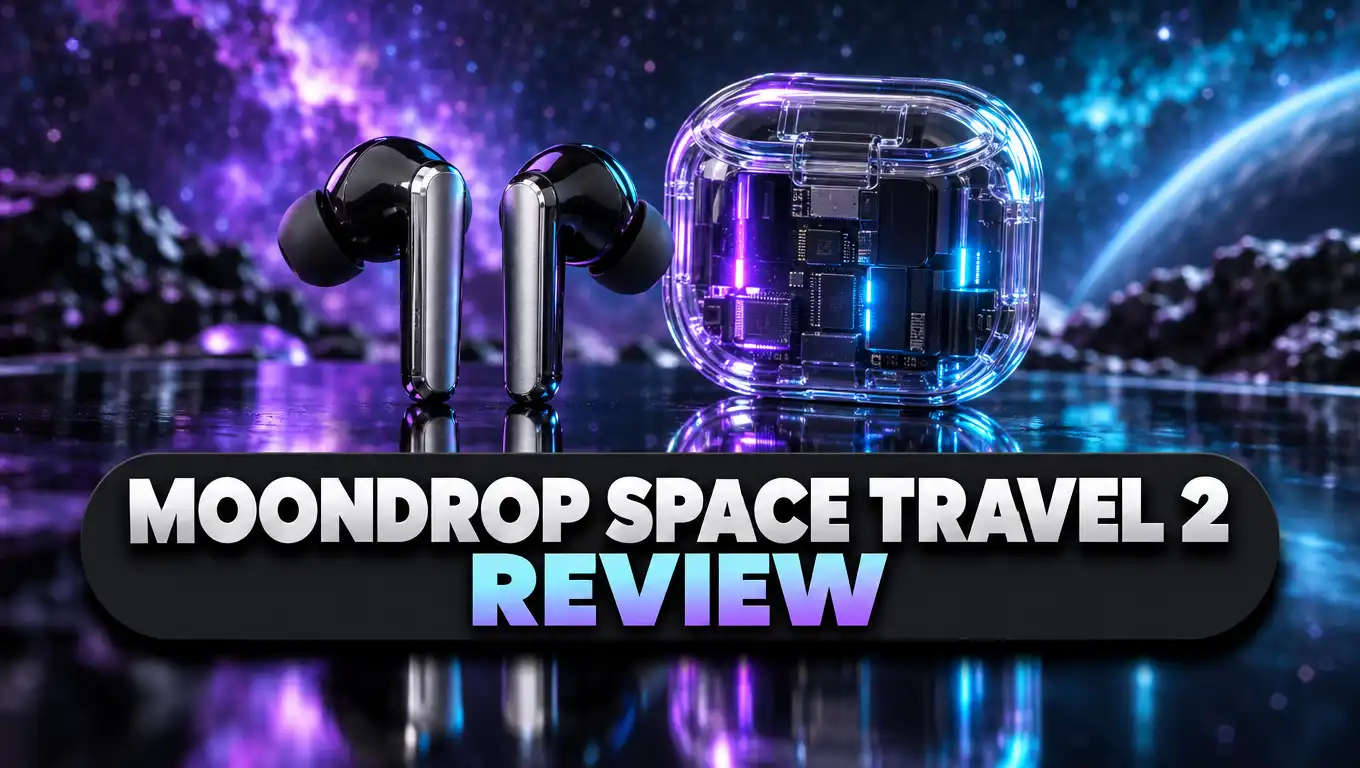
The Moondrop Space Travel 2 is a budget true wireless earbud with active noise cancelling. Moondrop is a Chinese audio brand. It is famous among IEM fans for its sound tuning and its anime themed packaging.
The model number is MD-TWS-046. It runs on Bluetooth 6.0 and supports a range of about 10 meters. The codecs are SBC and AAC only.
Inside each earbud sits a 13mm dynamic driver. It uses a composite diaphragm with a beryllium plated dome. Moondrop says this larger driver gives lower distortion and better treble extension.
The feature list is long for the price. You get hardware level AI noise cancelling through a built in NPU. You also get a 55ms low latency game mode and dual device connection.
Moondrop calls it “The Sound Benchmark of Budget oriented TWS.” That is a bold claim. As you will see, reviewers do not fully agree on it.
The earbuds come in a few colors. Options include black, white, and an orange and white version. The orange one has a fun cyberpunk look.
Pricing is the real headline here. SoundGuys noted a launch price of $25.49 on Amazon. That puts it in the same price bracket as many no name earbuds.
So what makes it stand out? The answer is mostly the sound tuning and the new app. Let us dig into each part one by one.
Unboxing and Accessories
The box is simple, but it covers the basics. Inside, you get the earbuds, the charging case, a USB charging cable, and eartips. For a $30 product, that is a fair package.
The eartip selection is a nice surprise. Moondrop includes four sizes of oval shaped eartips. Many IEMs that cost five times more include only three sizes.
The oval shape matters. It matches the oval nozzle on the earbud. This helps keep a steady seal while you talk or chew.
There are a couple of small letdowns. The charging cable is USB A on one end. If your laptop or charger only has USB C ports, you will need an adapter.
The case also has no lid. It is open on top, just like the first Space Travel. Dust and lint can get inside if you toss it in a pocket.
Moondrop sells an extra cover case with a lid. It wraps around the original case. However, it makes the already large case even bulkier.
Packaging fans will notice the anime artwork. Moondrop always leans into this style. Some people love it, while others find it a bit silly.
Overall, the unboxing feels honest. You get what you need to start listening right away. Just keep a USB A port or adapter nearby.
Design and Build Quality
The Space Travel 2 looks almost the same as the first model. The case is identical to the original. The earbuds use a stem design, similar in style to AirPods Pro.
The shell is made of lightweight plastic. It does not feel premium. But at this price, few buyers expect metal or glass.
The stems are rectangular, while the main body is round. Some reviewers find this mix of shapes a little odd. It is a small design quirk, not a deal breaker.
The case has a couple of handling issues. The earbuds use magnets to snap into place. Still, the stems can be tricky to slide in, and they sometimes pop back out.
Taking them out is also a bit fiddly. The open top design means you have to pinch the stems carefully. With practice, it gets easier.
There is no official IP rating listed for water or sweat resistance. If you plan to sweat hard at the gym, keep this in mind. Light use should be fine, but there is no guarantee.
Touch controls sit on the stems. You can tap to play, pause, skip tracks, and switch ANC modes. A quadruple tap turns on game mode.
The good news is that you can customize the touch controls in the app. You can also choose which ANC modes the tap cycles through. This is a welcome upgrade over the first model.
In short, the build is basic but functional. It looks fun, it feels light, and it does the job.
Top 3 Alternative for Moondrop Space Travel 2
The Space Travel 2 is not for everyone. If you want different strengths, these three options are worth a look.
Moondrop Space Travel 2 Ultra

- Patent 13mm Annular Single-magnetic Planar Driver: Thenewly developed patented 13mm single-magnetic...
- Committed to the Unremitting Pursuit of Sound Quality: Based on the high quality hardware of patent...
Last update on 2026-11-27 / Affiliate links / Images from Amazon Product Advertising API
The Ultra is the upgraded sibling. It uses a 13mm planar driver instead of a dynamic driver. It also adds LDAC support for higher bitrate audio.
It costs around $40. One catch is that LDAC mode locks you out of the EQ. Some owners say they hear no clear difference between AAC and LDAC.
Moondrop Space Travel (Original)

- Single Feedforward with Lossless Sound Quality,35dB Depth Wide-band ANC: In order to achieve deep noise...
- 55ms Low-latency Game Mode,Music/Game Mode Switching: SPACE TRAVEL allows easy switching of dual...
Last update on 2026-11-27 / Affiliate links / Images from Amazon Product Advertising API
The original Space Travel is still a strong pick. SoundGuys preferred its tuning over the sequel. It has fuller bass and better treble extension out of the box.
It launched at $24.99 and uses Bluetooth 5.3. The app is very limited, though. Choose it if you want good sound with zero tweaking.
Soundcore P40i by Anker

- Adaptive Noise Cancelling: soundcore P40i noise cancelling earbuds are designed with adaptive ANC...
- Long, Powerful Battery Life: Enjoy 12 hours of battery life on a single charge with a case that extends...
Last update on 2026-11-27 / Affiliate links / Images from Amazon Product Advertising API
The Soundcore P40i is the pick for everyday users. It offers adaptive ANC, heavy bass, and up to 60 hours of total playtime. The case also works as a phone stand.
It costs a bit more than the Space Travel 2. In return, you get much better battery life and IPX5 water resistance.
Comfort and Fit
Comfort is a mixed bag with the Space Travel 2. It depends a lot on your ear shape. Some people wear them for hours, while others get sore quickly.
SoundGuys found the fit easy. Their tester wore them for hours without major issues. The shallow fit design helps here.
The headphones.com reviewer had a different experience. The outer shell pressed on the top back part of the ear. After about two hours, their ears felt sore.
The oval eartips are a big plus. They keep the seal steady when you move your jaw. That means no seal breaks while talking or eating, which many round tip IEMs cannot claim.
A good seal does two jobs. It improves bass, and it helps the ANC work better. So take time to try all four tip sizes.
Here are some quick fit tips. Start with the medium tips. Twist the earbud gently back until it feels secure. If the bass sounds thin, try a larger size.
The earbuds are very light. This helps reduce fatigue during commutes or short work sessions. They do not stick out too far from your ears either.
For long flights or full workdays, you may want breaks. Test them for a week before deciding. Most people will find a comfortable fit with the right tips.
Sound Quality Out of the Box
Sound is where this earbud gets the most attention. It is also where reviewers disagree the most. Let us look at both sides.
The headphones.com reviewer loved it. They called the tuning warm neutral, with modest bass and soft treble. They even said it was easily their favorite Moondrop product to date.
The bass rises gently instead of jumping up. This keeps voices and pianos sounding smooth across their range. Kick drums and bass guitars still have texture and snap.
The mids lean slightly warm in the lower range. There is a small lift in the upper mids around 2 kHz. Some vocals may sound a bit small or plasticky at times.
The treble is tilted dark. You get no harsh sizzle and no sibilance. Cymbals sound natural, but some listeners may find the top end too dull.
SoundGuys had the opposite view. Their tester found the stock sound compressed and mid focused. It felt like vocals were shouting from a few feet away.
Their lab measurements showed underemphasized bass and treble. That means many casual listeners may find it flat. Bass lovers will likely want to use the EQ.
Soundstage stays fairly inside your head. Detail is smooth rather than sharp. Dynamics are a pleasant surprise, with good punch on well mixed drum tracks.
So who is right? Both are, in a way. If you like balanced, non fatiguing sound, you will enjoy it. If you want big bass and sparkle, plan to use the EQ.
The Moondrop App and Parametric EQ
The new Moondrop app is the biggest upgrade in this model. The first Space Travel had only two EQ options. The Space Travel 2 changes the game.
The headline feature is a 5 band parametric EQ. You can set the frequency, gain, and Q for each band. Points can go anywhere from 20 Hz to 20,000 Hz.
This is rare at any price. Many big brands with better chips do not offer full PEQ. Audio fans will feel right at home here.
The EQ saves directly on the earbuds. So if you switch from your phone to your laptop, your sound stays the same. That is a smart touch.
There are simple presets too. Bass+ and Bass minus add or cut 3 dB at 200 Hz. If you just want more thump, Bass+ is a quick fix.
The app also has a community feature. You can upload your EQ preset and share it. Other users can search and download it in seconds.
You can even overlay a target curve. This makes it easier to match popular tuning targets.
There are a few limits. Boosts max out at +3 dB, and there is no pregain control. You only get peak filters, with no shelf filters.
The app also offers three gain modes: low, medium, and high. High gain is very loud. Most people will only need it when using lots of EQ cuts.
Active Noise Cancelling and Transparency Mode
The Space Travel 2 uses single feedforward ANC. Moondrop pairs it with an NPU for AI based noise cancelling. On paper, that sounds impressive.
In SoundGuys testing, ANC cut outside noise by an average of 71%. That beats the first model’s 68%. Office hum and train rumble dropped to manageable levels.
However, human speech stayed easy to hear. ANC on budget earbuds often struggles with voices, and this one is no exception.
Wind is the biggest weakness. In windy places, the ANC made wind noise louder instead of reducing it. If you walk outside a lot, this can get annoying.
The headphones.com reviewer was much harsher. They said the ANC and transparency mode barely do anything. They also noticed loud low frequency thrumming at times.
Another issue is microphone headroom. Simple sounds, like opening a soda can, can cause the mics to clip. You may hear a sharp pop in your ears.
Transparency mode works for quick chats. But it sounds a bit narrow and unnatural. Do not expect AirPods Pro level clarity here.
Passive isolation is also below average for IEMs. So a good tip fit matters even more.
The bottom line is simple. ANC is a bonus, not a main feature. If you need strong noise cancelling, brands like Sony, Bose, and Apple still lead by a wide margin.
Battery Life and Charging
Battery life is one of the weakest areas of the Space Travel 2. Small earbuds mean small batteries, and it shows here.
Each earbud has a 35mAh battery. The case holds 380mAh. Moondrop claims about 7 hours per charge and 24 hours total with the case in AAC mode.
Real world tests tell a different story. SoundGuys measured 4 hours and 20 minutes with ANC on. That is near the bottom of what they have tested.
A Head-Fi reviewer saw similar results. They got around 4.5 hours in AAC mode with ANC on.
The case adds a few more charges. SoundGuys estimated about 12 hours of total playback with ANC on. That is enough for a commute, but not a full day of heavy use.
You can stretch battery life in a few ways. Turn off ANC when you are in a quiet room. Keep the volume moderate. Avoid high gain mode unless you really need it.
Charging uses a standard 5V 1A input. There is no wireless charging. You will need that USB A cable or your own USB C cable.
Battery life is basically a tie with the first Space Travel. So there is no upgrade here.
If long battery life matters most, the Soundcore P40i is a better pick. It offers up to 60 hours with the case.
Connectivity, Bluetooth 6.0, and Game Mode
The Space Travel 2 jumps from Bluetooth 5.3 to Bluetooth 6.0. That sounds like a big leap. In practice, it does not change much yet.
The earbuds support only SBC and AAC. There is no aptX, no LDAC, and no LC3. LE Audio and Auracast are also missing for now.
AAC works great on iPhones and most Android phones. So for most people, the codec limit is not a huge problem.
Dual device connection is a nice touch. You can link your phone and laptop at the same time. Switching between them is quick and easy.
The earbuds also support mono mode. You can use one earbud on its own, and it switches back to stereo automatically.
Game mode drops latency to about 55ms. You turn it on with a quadruple tap. This helps with mobile games and videos.
There are some quirks. SoundGuys still noticed small audio delays in videos, even with game mode on. The earbuds also reset to music mode each time you reconnect.
Headphones.com noticed brief lag between the two earbuds at times. It usually fixes itself quickly. But it can feel annoying on a new product.
You will also hear anime voice prompts when you connect or switch modes. Some find them charming, while others find them cringe.
Microphone and Call Quality
The Space Travel 2 handles calls well enough for daily use. The mics pick up your voice clearly in quiet rooms. People on the other end can understand you without trouble.
SoundGuys tested the mics in several settings. These included an office, a street, a windy area, and a room with echo. Voices stayed front and center in most tests.
Wind is again the main problem. In windy conditions, the mic quality drops a lot. Callers may hear rushing noise over your voice.
The sound is not fully natural. Your voice may sound a little processed. Still, it does not sound bad, and words stay clear.
Compared to the first Space Travel, the mic is nearly the same. SoundGuys found it hard to hear any difference between the two.
Here are a few tips for better calls. Face away from the wind when you can. Step into a quiet spot for important calls. Make sure the earbuds sit firmly so the mics point at your mouth.
For Zoom calls at home, the mics are fine. For calls on busy streets, you might want a better option.
If you take lots of work calls, consider a model with more mics and stronger noise reduction. The Space Travel 2 is built mainly for music, not for calls.
Space Travel 2 vs the Original Space Travel
This is the comparison many buyers care about. Should you get the new model or stick with the old one? The answer depends on how you listen.
The two share the same case and same fit. Battery life is the same too. Both scored 4 hours and 20 minutes in SoundGuys testing.
The Space Travel 2 wins on features. It has Bluetooth 6.0, a full PEQ app, custom controls, and slightly better ANC. If you love tweaking, this is a clear upgrade.
The original Space Travel wins on stock sound, according to SoundGuys. It measured closer to their preference curve. It has stronger bass and better treble extension.
SoundGuys even gave a blunt verdict. They said to just get the Space Travel 1 if you want great sound without any adjustments.
Price is very close. The original launched at $24.99, and the sequel launched at $25.49. Stock for the original may shrink as the new model takes over.
Here is a simple way to choose. Pick the original if you want plug and play sound. Pick the Space Travel 2 if you enjoy EQ and want newer features.
If you already own the first model, there is little reason to upgrade. The new app is great, but the core experience feels similar.
Pros and Cons
Here is a quick summary of the strengths and weaknesses.
Pros
- Very low price. You get ANC, an app, and dual device support for around $25 to $30.
- Excellent parametric EQ. The 5 band PEQ gives you real control over the sound, which is rare at this price.
- EQ saves on the earbuds. Your custom sound follows you across phone, tablet, and laptop.
- Community EQ sharing. You can download presets made by other users in just a few taps.
- Warm, non fatiguing tuning. The smooth treble makes long listening sessions easy on the ears.
- Oval eartips with four sizes. The fit stays sealed when you talk or chew.
- Low latency game mode. The 55ms mode helps with mobile gaming and video.
Cons
- Short real world battery life. Expect about 4 to 4.5 hours with ANC on.
- Weak ANC and transparency. Wind noise gets worse, and the mics can clip with sudden sounds.
- Divisive stock sound. Some reviewers find it flat, mid focused, and light on bass.
- No lid on the case. Dust and lint can get in easily.
- No high quality codecs. Only SBC and AAC are supported.
- Comfort varies. Some users report sore ears after a couple of hours.
- No official water resistance rating.
Final Verdict: Should You Buy It?
The Moondrop Space Travel 2 is a strange but exciting earbud. It is not the best all rounder. But it does a few things very well for very little money.
Its real strength is sound customization. The parametric EQ turns a solid baseline into something special. The headphones.com reviewer said they preferred it over AirPods Pro 2 for pure music listening.
That is high praise for a $30 product. Few budget earbuds get compared to Apple in a positive way.
Its weak spots are clear too. Battery life is short. ANC is basic. The case is lidless, and comfort is hit or miss.
So who should buy it? It is great for audio fans on a budget. It also works well for students who want a cheap study companion. If you enjoy playing with EQ, you will get a lot out of it.
Who should skip it? Skip it if you need strong noise cancelling for flights. Skip it if you want all day battery. Also skip it if you want big bass with zero setup.
For those buyers, the Soundcore P40i or the original Space Travel may be better choices.
Overall, I would give it a solid 7.5 out of 10. It is a fantastic tool for tinkerers and a decent pick for everyone else. At this price, it is hard to go very wrong.
FAQs
Is the Moondrop Space Travel 2 worth buying?
Yes, if you like tweaking your sound. The 5 band parametric EQ is rare at this price. If you want strong ANC or long battery life, look at other options.
Does the Moondrop Space Travel 2 support LDAC?
No. It only supports SBC and AAC. For LDAC, you need the Space Travel 2 Ultra, which costs a bit more.
How long does the battery last?
Moondrop claims 7 hours per charge and 24 hours with the case. Lab tests with ANC on measured about 4 hours and 20 minutes per charge.
Is the Space Travel 2 better than the original Space Travel?
It has better features, like Bluetooth 6.0 and a full EQ app. But SoundGuys preferred the stock sound of the original model. Choose based on whether you want to use EQ.
Is the Space Travel 2 waterproof?
There is no official IP rating listed. Avoid heavy sweat and rain to be safe.
Does the Space Travel 2 work with iPhone?
Yes. It works with iPhone and Android through Bluetooth. AAC is a good fit for iPhones, and the Moondrop app gives you access to the EQ.
Can I use one earbud at a time?
Yes. The earbuds support mono mode and switch back to stereo automatically.
Is the Space Travel 2 good for gaming?
It has a 55ms low latency game mode, which helps with mobile games. Some users still notice a small delay, so serious gamers may want a wired option.

Dillip is the founder and editor of dillip.net, a passionate tech enthusiast and AI explorer dedicated to simplifying the world of artificial intelligence and technology for everyday users. With a keen eye for detail, he provides honest reviews, in-depth comparisons, and practical guides to help readers make smarter tech decisions.